“Decoding Your Diagnosis: How You Can Partner with Your Pathologist for Better Cancer Care” (Mich...
Brad Power
November 4, 2026
“I want patients to know that pathologists are available to discuss and educate them about options as innovations, biomarkers, and other transformative changes happen in the field of pathology. Don't ever feel discouraged. I want you to feel empowered to reach out to your pathologist.” – Lija Joseph, MD, pathologist
“I hold no formal power, but I do have a voice, and I will continue to use it until every patient knows that they're important, and every doctor, pathologist included, realizes there is a patient behind that lens.” – Michele Mitchell, patient advocate
Overview
Empower your cancer care journey by discovering the vital, yet often hidden, role your pathologist plays in your diagnosis and treatment. Pathologist Lija Joseph, MD, explains how you can directly connect with pathology experts to better understand groundbreaking innovations, biomarkers, and evolving treatment options. Patient advocate Michele Mitchell shares an inspiring reminder of the power of your voice in ensuring medicine always sees the patient behind the lens. Years after being declared “cancer free,” a pathologist shared new information about her breast cancer diagnosis, and understanding it was empowering and transformative. You will learn how to partner with your medical team, advocate for your care, and feel completely empowered throughout your health journey.
Summary
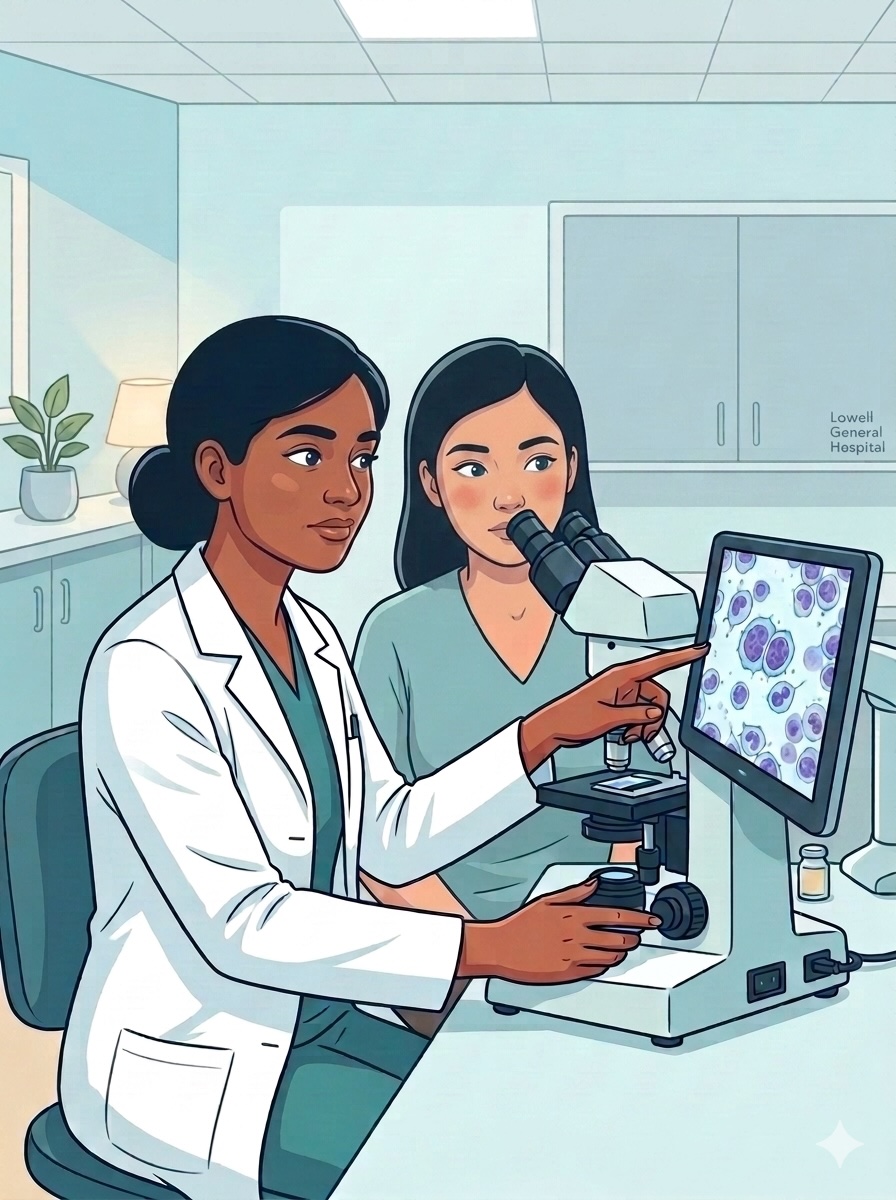
Navigating a cancer diagnosis can feel like stepping into a foreign country without a map, where patients and caregivers are instantly flooded with complex medical jargon, overwhelming treatment choices, and intense anxiety. Amidst this chaos, the pathology report—the very document that dictates your exact diagnosis and treatment plan—often remains a locked mystery behind technical terms, leaving families feeling like passive recipients of care rather than active partners in their own healing. To help you bridge this gap and reclaim control of your journey, consider the advice of Michele Mitchell, BS, MS, PMP, a 25-year healthcare leader, breast cancer survivor, and award-winning patient advocate dedicated to amplifying the patient's voice, and Dr. Lija Joseph, a pathologist at Lowell General Hospital who works tirelessly to bring the laboratory directly to the patient. Together, they pull back the curtain on the lab to show you exactly how to understand your results, see the "life behind the slide," and transform your relationship with your medical team.
Why do you need to know about the role of the pathologist in your cancer care?
Be more engaged in your care: Understanding the pathologist's role transforms you from a passive recipient of care into an active, empowered partner who can confidently advocate throughout your healing journey.
Demystify your diagnosis: The pathology report is the absolute foundation of your cancer care; knowing how it is created helps you understand the exact data guiding your oncology team's treatment decisions.
Diversify your medical advice: Collaborating with pathologists allows patients and caregivers to collaborate on personalized treatments and directly discuss vital options like biomarkers and clinical innovations.
Keep up with innovations: Advancements in digital pathology and new technologies are rapidly expanding your access to medical data, making it easier to secure second opinions and navigate advanced care options. The Information Blocking Rule under the 21st Century Cures Act prohibits practices by health care providers, health IT developers, and health information networks/exchanges that are likely to interfere with, prevent, or materially discourage the access, exchange, or use of electronic health information. The information unblocking rule mandates the release of the pathology to your patient portal without unnecessary delay once the result is made available to the clinician. Exact timing can vary by health system, and in many cases you may see your report before the ordering physician has had time to review it.
How does your pathology report get created, and how does it dictate your treatment choices?
Your tissue sample goes through a meticulous lab process where specialized medical technicians prepare it and a pathologist examines it under a high-powered microscope.
The pathologist answers the most critical questions: they identify the exact type of cancer, its stage, how fast it is growing, and whether it has spread.
This report acts as the master blueprint that your oncologists, surgeons, and radiologists must follow to design your surgery, chemotherapy, or radiation plan.
How can you directly connect and collaborate with a pathologist to unlock your personalized care and understand your biomarkers?
Ask your oncologist or surgeon to arrange a conversation or a consultation with the pathologist who reviewed your specific case.
Bring a copy of your pathology report to your appointment and ask the pathologist to walk you through the technical terms line by line so you fully understand your diagnosis.
Ask your pathologist to explain "biomarkers", the specific genetic features or proteins in your tumor that reveal exactly which targeted therapies or immunotherapies will work best for you.
How are digital health innovations making it easier for you to access your medical data and get second opinions?
Records access: Online patient portals give you direct, transparent access to your own lab results, helping you keep track of your information and share it seamlessly with your entire care team.
Sharing: Digital pathology turns physical glass slides into high-resolution digital images that can be viewed securely on a computer screen from anywhere. It allows your files to be instantly shared with leading experts across the country, making it incredibly fast and easy to get a second opinion without mailing physical slides.
Interpretation: You can utilize AI tools to instantly translate complex pathology report terminology into plain, easy-to-understand language before you even meet with your doctor.
How can you learn more about pathology, partnering with your pathologist, and engaging in your care?
Contact Lija Joseph at lija.joseph@lowellgeneral.org or Michele Mitchell at mmmitchell99@gmail.com or https://www.linkedin.com/in/michele-mitchell-403361135/
Check out MyPathologyReport.com, In preparation for a meeting with your pathologist or clinician, a resource like the MyPathologyReport.com website can be a trusted place to get your questions answered and to develop a comprehensive list of questions for your appointment. All of the information is vetted and written by pathologists, with review by Michele Mitchell, the sites patient advocate volunteer. Her role is to make sure the articles on MyPathologyReport.ca are clear, supportive, and patient-friendly. This free website is internationally recognized as a clear, accurate, and trustworthy source of medical information.
Review the College of American Pathologists patient section, which offers comprehensive guides on how pathology results are decided, questions to ask your doctor, and resources explaining how pathologists work behind the scenes to guide your treatment.
Check your hospital's portal to see if they offer direct consultation requests or a "Meet Your Pathologist" program, which allows patients to look at their slides alongside a laboratory expert.
Additional References
“New Study Shows Patients prefer immediate access to test results and unmet information needs”
Pathologists, Clinicians, Patients Statistics on Offering Pathology Clinics:
See previous Cancer Patient Lab webinars, such as:
The information and opinions expressed on this website or platform, or during discussions and presentations (both verbal and written) are solely for educational purposes and are not intended as health care recommendations or medical advice by Cancer Patient Lab, its principals, presenters, participants, or representatives for any medical treatment, product, or course of action. You should always consult a doctor about your specific situation before pursuing any health care program, treatment, product or other course of action that might affect your health. This summary was prepared with the assistance of transcription and AI-assisted editing tools and was reviewed by Cancer Patient Lab staff.
For the video recording, please see here.
For the slides, please see here.
For a transcript of the conversation, please see here.