Please Help: A "Hackathon" for a Patient with Widespread Stomach Cancer [#216]
Brad Power
October 23, 2026
“He's had nine treatments. He's having a deep response… I want to work with a community like this one while we are having some stability to see what else we can do to basically put him into remission.” – caregiver to ND
“We're looking at personalized vaccines, and we've made the most progress there. Where I haven't made much progress is in ADCs or radioligand therapy, if there is any such thing. We also have made some progress in trials, though there are no trials in our community that are appropriate. I've looked at CAR T in China, but ND is not excited to move to China. And what I will say is, I'd love to have a multifactorial approach here. Where trials make me nervous is it's hard to do a lot once ND would be on a trial, and we might lose some time.” – caregiver to ND
“My main takeaway is how lucky I am to have met you, Brad, and thank you for sharing your community with me, and to Darren also, who has been a hero. I'm really grateful to all of you. It's unbelievable that you would spend an hour of your morning with me. This is very hard, and I feel very grateful.” – caregiver to ND
Abstract
We invite clinicians and researchers in gastric cancer, genomics, bioinformatics, immunology and clinical trials to contribute to an ongoing research collaboration for a patient with advanced gastric cancer.
The group is exploring questions about tumor data, candidate vaccine targets, investigational treatments and gaps in testing. These are research questions, not validated treatment recommendations; care decisions remain with the patient and treating team.
Interested in contributing? Contact Brad with your background and proposed contribution. Detailed clinical and genomic records and case discussions are limited to collaborators approved by the patient and family through the private Care Circle. The public discussion hub may be used for general methods and non-identifying research questions only.
Hackathon Overview
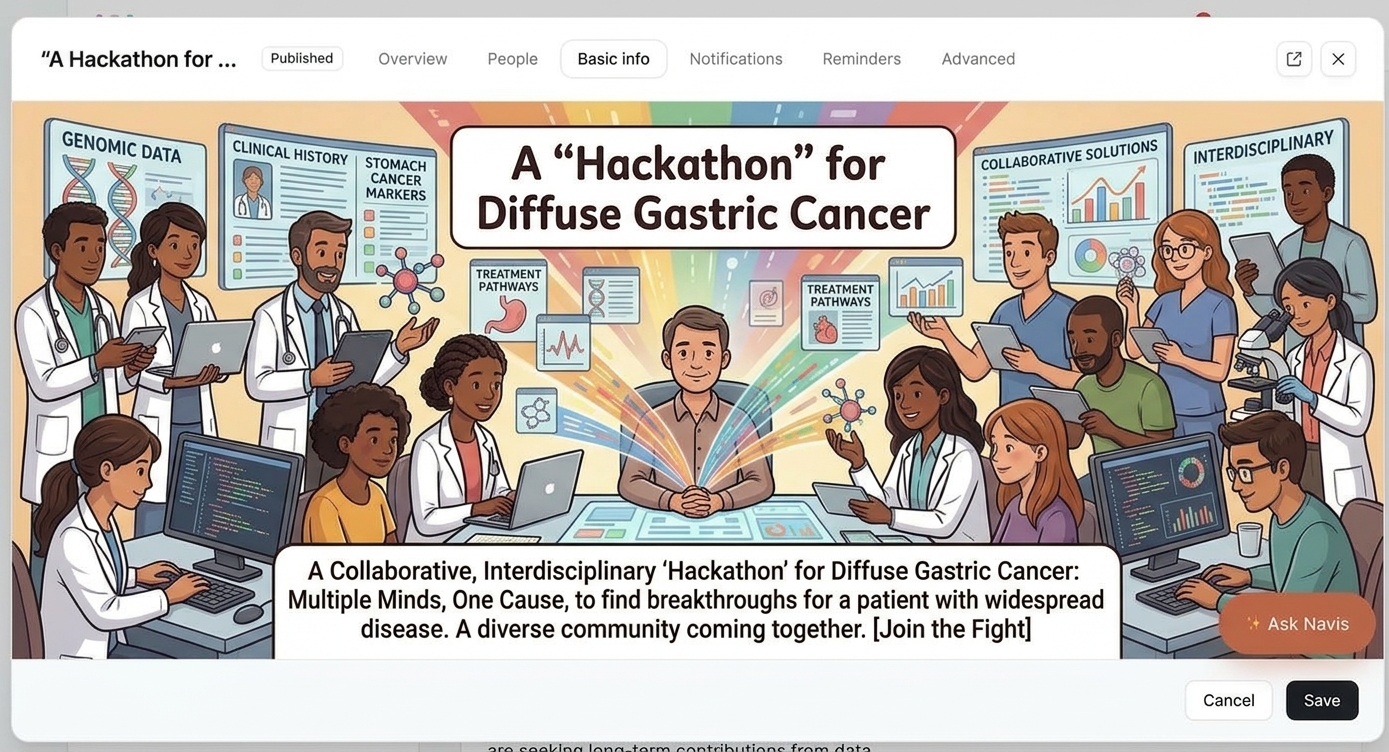
A Collaborative, Interdisciplinary “Hackathon” for a Patient with Diffuse Gastric Cancer
You are cordially invited to join an ongoing, multidisciplinary “hackathon” – a collaborative effort focused on a stomach cancer patient who has made his comprehensive clinical and genomic datasets available to invited collaborators. Our dual mission is to chart the optimal clinical path forward for this patient and to generate foundational insights that can benefit the broader community of patients fighting diffuse gastric cancer. We are seeking long-term contributions from data scientists, bioinformaticians, immunologists, oncologists, and clinical trial experts to continuously analyze evolving data and solve complex, testing and treatment decisions and overcoming systemic access hurdles.
What has been the story of ND’s cancer care?
Sudden Diagnosis: In January 2024, a man felt sudden, severe stomach pain while skiing. A camera test of his stomach revealed an ulcer that turned out to be stomach cancer.
Surprise After Surgery: Doctors first thought the cancer was at an early stage (Stage 2B), not that aggressive. However, after a complex surgery to remove his entire stomach, doctors found the cancer had spread to 22 out of 46 nearby lymph nodes, meaning it was actually at a higher, more aggressive stage.
Chemotherapy Didn't Work: The standard chemotherapy treatment he received before surgery did not stop or shrink the cancer, which meant the standard treatments were not the right match for his specific cancer.
Found Key Targets: The family pushed for special genetic tests on the tumor. These tests discovered two important proteins on his cancer cells, called Claudin 18.2 and PD-L1, which gave doctors specific targets to aim for.
The Cancer Returned: After a year of immunotherapy, a specialized liquid biopsy blood test (called Signatera) which monitored his cancer, turned positive in early 2026. A scan and bone biopsy confirmed the cancer had spread to his spine.
Success with New Treatments: Because they knew about his specific tumor targets, doctors started a new combination of chemotherapy and targeted drugs (including a new medicine called zolbetuximab). This personalized treatment has successfully lowered his cancer blood markers close to zero, showing a deep and positive response.
What are the questions that ND and his caregiver would like to answer now?
Finding the Best Next Treatments
What are the most promising next treatment options? We are looking into personalized cancer vaccines, antibody-drug conjugates (ADCs), radioligand therapy, and other advanced clinical trials, potentially combining them if they can be tolerated safely.
Are there specific cancer markers we should test for? Have key gastric cancer markers like TROP2, Nectin-4, and EGFR been checked yet?
How does previous treatment affect future trial options? We need to evaluate next-generation treatments (like those targeting CLDN18.2) and understand how a patient's eligibility for these trials is impacted by having already received the drug zolbetuximab.
How do we pick the safest, fastest strategy? How can we choose a path that moves quickly toward remission without accidentally locking the patient out of other valuable treatment choices later?
Using Existing Data and Identifying Gaps
How can we use our current data to pick the right treatment? How do we best use the available genetic and tumor testing data to choose between our options?
Are there flaws or limitations in our current genetic data? When looking at the genetic mutations in the primary stomach tumor versus the spine tumor, are there limitations we need to be aware of—specifically regarding how the blood sample was used as a baseline comparison for identifying vaccine targets?
Are we missing any important data? What are the highest-priority missing tests (genomic, RNA, or tissue-based) that would give us the most useful answers in the shortest amount of time?
Could blood-based tracking help us catch changes early? Could circulating tumor cell (CTC) testing provide helpful information right now?
Managing Tumor Tissue and Biopsies
What is the status of ND’s tumor tissue samples? How much preserved tissue is actually left for additional testing?
Is a new biopsy possible and useful? Can any of the current tumor spots be safely biopsied, and what advanced testing can realistically be done with that new tissue or with blood?
Tracking Treatment Response and Toxicity
How do we find a safe vaccine target? How do we identify, rank, and prove that a specific genetic target is truly active and safe before moving forward with a personalized vaccine?
How do we balance treatment strength against severe side effects? How can we use serial liquid biopsies (ctDNA blood tests) alongside regular scans to decide when it is safe to lower a treatment dose, pause therapy, or maintain the current plan when the side effects are very severe?
How can you help answer these questions?
We invite clinicians and researchers in gastric cancer, genomics, bioinformatics, immunology and clinical trials to contribute to this ongoing research collaboration for a patient with advanced gastric cancer.
The group is exploring questions about tumor data, candidate vaccine targets, investigational treatments, and gaps in testing. These are research questions, not validated treatment recommendations; care decisions remain with the patient and treating team.
To participate, contact Brad at bradpower@cancerpatientlab.org with your background and proposed contribution. Detailed clinical and genomic records and case discussions are limited to collaborators approved by the patient and family through the private Care Circle. The public discussion hub may be used for general methods and non-identifying research questions only.
What data is available to help us answer these questions?
Medical history: Diagnosis, surgeries, treatments, and how the cancer has changed over time.
Scans and biopsy: A scan found cancer in the spine, and that spot was biopsied. More imaging was planned.
Tumor test results: Reports mention HER2-negative, possible EGFR-positive, and high Claudin 18.2. The full reports should be checked to confirm details.
Blood tests: Natera Signatera results were tracked over time; the latest level was 0.4.
Tumor samples and sequencing: Some preserved tissue may be available. The group also discussed RNA-sequencing and DNA data from the original tumor and a later metastasis.
Additional data: Circulating-tumor-cell data is available to share.
Still to confirm: How much tissue remains, whether other markers (such as TROP2 and Nectin-4) were tested, and the details of the treatment-options list.
How can you learn more about “hackathons”?
See previous hackathons, including:
Hillel Bierbrier, a man with an aggressive anal cancer and limited treatment options
Bryce Olson, an advanced prostate cancer who had run out of options
Kasey Altman, a young woman with a rare cancer (rhabdomyosarcoma) which had no effective standard treatment options
Linnea Olson, a woman failing the targeted treatment she had received for her non-small cell lung cancer
Marlo Kwong, a 2-year-old with a rare sarcoma
Elliott Davis, a man who has been battling metastatic prostate cancer for 11 years, running out of treatment options
The information and opinions expressed on this website or platform, or during discussions and presentations (both verbal and written) are solely for educational purposes and are not intended as health care recommendations or medical advice by Cancer Patient Lab, its principals, presenters, participants, or representatives for any medical treatment, product, or course of action. You should always consult a doctor about your specific situation before pursuing any health care program, treatment, product or other course of action that might affect your health. This summary was prepared with the assistance of transcription and AI-assisted editing tools and was reviewed by Cancer Patient Lab staff.
For the video recording, please see here.
For a transcript, please see here.