“Stop Guessing, Start Testing: Overcoming the Trial-and-Error Trap in Cancer Care with Drug Sensi...
Brad Power
October 14, 2026
“Functional precision medicine, or ex vivo drug sensitivity testing, is a valuable source of information for cancer patients and oncologists. There's been a lot of advances in the field, particularly in the last ten years.” – Edward Chow, PhD
“If access to tissue is not a problem, there is a benefit to sending your sample to multiple FPM companies and seeing if orthogonally the different companies can identify overlapping results, which would then obviously give greater confidence to that next line of treatment.” – Edward Chow, PhD
“Don't be afraid to ask questions. Don't be afraid to advocate for yourself. It can definitely make a difference… Depending on the hospital or the clinic and the surgeon and the doctor, there's various levels of enthusiasm for taking that extra step of collecting fresh tissue. The biggest driver is patients advocating for themselves, and we found that even the most reticent medical institutions, if the patient strongly advocates for this, will do it for the patient.” – Edward Chow, PhD
Abstract
Are you tired of the high-stakes guessing game that often defines standard cancer treatments? Advanced Functional Precision Medicine and drug sensitivity (“functional“) testing can analyze your live tumor tissue against multiple therapies before you ever take them, eliminating the toxic trial-and-error approach to care. Dr. Edward Chow highlights how sending samples to multiple laboratories can reveal overlapping results to give you and your doctor maximum confidence in your next line of treatment. Most importantly, it serves as a powerful action guide for self-advocacy, proving that when patients and caregivers firmly demand fresh tissue collection, even the most hesitant medical institutions will comply. Learn how to take control of your data, navigate tissue access, and collaborate with your medical team to unlock a truly personalized roadmap for your health.
Meeting Summary
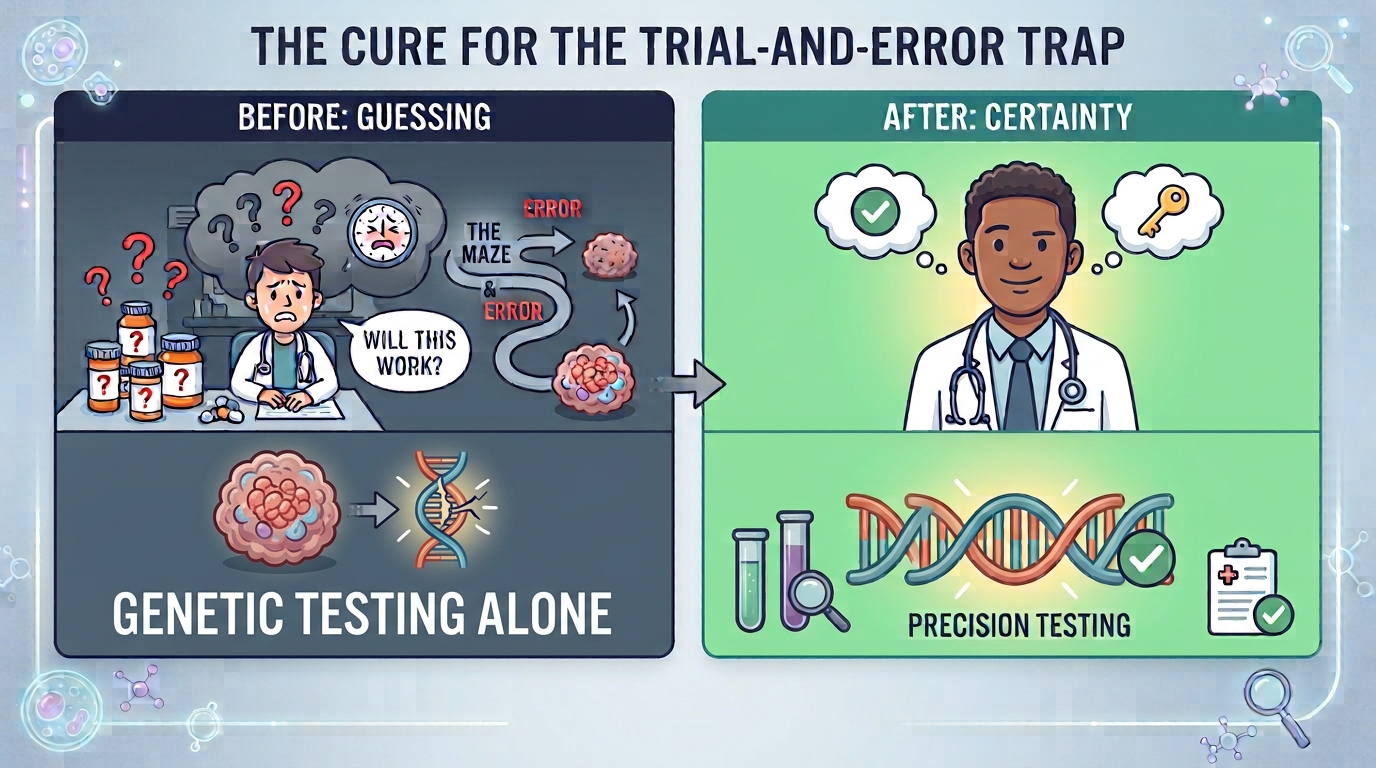
When facing cancer, you cannot afford to waste time on treatments that might not work. While DNA sequencing provides a helpful genetic blueprint, it cannot guarantee how your living tumor will actually respond to a specific therapy, often leaving families trapped in a stressful, exhausting cycle of trial-and-error medicine. Drug sensitivity testing (or functional testing) tests drugs directly on live tumor tissue to predict success before treatment begins. World-class oncology pioneer Dr. Edward Chow describes how you can stop guessing and start testing to find the most effective path forward.
Why do you need to know about drug sensitivity (“functional”) testing?
It tests how your cancer cells respond to certain drugs or drug combinations.
It may offer useful information when usual treatments aren’t working, the cancer is rare or complex, or there are several treatment options.
It can complement genetic testing by providing a different kind of information.
What does drug sensitivity (“functional”) testing add that standard cancer testing misses?
Predicts actual drug response: Standard genomic testing only provides a DNA blueprint, whereas functional testing exposes live tumor cells directly to drugs to see if they actually work.
Reduces trial-and-error: Instead of relying on general population data that may fail the individual, it helps avoid the stressful process of trying ineffective treatments and enduring unnecessary side effects.
Evaluates drug combinations: It can test how live cells respond to specific mixtures of medications, which standard DNA tests cannot easily predict.
Identifies options without DNA markers: It provides actionable information even when a tumor's genetic report shows no clear therapeutic targets.
Navigates treatment resistance: It helps find alternative options if a cancer has evolved and stopped responding to standard protocols.
What is drug sensitivity (“functional”) testing?
What it is: It is a lab test that checks how your cancer cells respond to selected cancer drugs.
How it works: A sample containing live cancer cells is collected and sent to a lab. The lab exposes the cells to selected drugs and combinations, then measures how the cells respond.
How results are generated: The test uses those measurements and an analysis method to estimate responses to different treatment options and rank them.
How can you advocate for access to drug sensitivity (“functional”) testing?
Ask your doctor whether drug-sensitivity (“functional”) testing could help guide your treatment. If you’re considering it, bring it up before a biopsy or surgery so the team can plan to collect and preserve suitable tissue.
Ask the test provider about evidence for your cancer type, sample needs, turnaround time, cost, and possible reimbursement.
Review results and treatment risks with your doctor.
How can you learn more about drug sensitivity (“functional”) testing?
AI: learn terminology, find questions to explore, and help summarize research.
Your medical team: Review what you learn with your medical team, who can interpret it in the context of your diagnosis and care.
Patient communities and support groups: Find patients who have gotten drug sensitivity (“functional”) testing.
Experts: Contact Edward Chow at echow@kyantechnologies.com.
Cancer Patient Lab webinars: See previous webinars on drug sensitivity (“functional”) testing, such as:
“Personalizing Cancer Care” (Cliff Reid, Chris Apfel, MD) [#184]
"Functional Drug Testing and AI/ML for Treatment Decisions" (Noah Berlow and Diana Azzam) [#18]
"Using Functional Profiling to Predict Drug Response" (Dr. Robert Nagourney) [#30]
“Finding Personalized Cancer Treatments Beyond the Standard through a Unique Test” (Travera) [#77]
“Managing Your Tissue for Cancer Analysis” (Bernardo Cordovez) [#198]
The information and opinions expressed on this website or platform, or during discussions and presentations (both verbal and written) are solely for educational purposes and are not intended as health care recommendations or medical advice by Cancer Patient Lab, its principals, presenters, participants, or representatives for any medical treatment, product, or course of action. You should always consult a doctor about your specific situation before pursuing any health care program, treatment, product or other course of action that might affect your health. This summary was prepared with the assistance of transcription and AI-assisted editing tools and was reviewed by Cancer Patient Lab staff.
For the video recording, please see here.
For the slides, please see here.
For a transcript of the conversation, please see here.