“Using AI and Genomics to Find the Right Treatment for Each Cancer Patient” (Edwin Alphonso, SJ S...
Brad Power
May 6, 2026
“When a patient asks, ‘Do you know what treatment is most likely to work for me?’, we should be able to give them the best possible option right now, instead of waiting for a lot of new drug discoveries or other stuff that's going to take five to 10 years. We need a solution today for patients, and that's what we're aiming for.” – Edwin Alphonso
“My goal is to build this continuous learning model so each year patients' data will help improve the next patient's care. I would greatly appreciate our community, whoever has the data, comes to us so we can build this together.” – Sophia Ren, PhD
“We have good tools in hand. We want to do good things for the patient, but we also need to find a place to cut in, by which I mean that if a doctor feels like there are several drugs and they don't know which one to start with, or the patient's case is much more complicated or rare, and they don't have clear guidelines, between Precision AI and Cellentia, we can jump in to help as quickly as possible and start to build a case and have people start to believe in this system so we can get more clinical collaboration to build this credibility. We welcome those who have those complicated cases to come to us, and then we can get that started.” – SJ Shih, PhD
Abstract
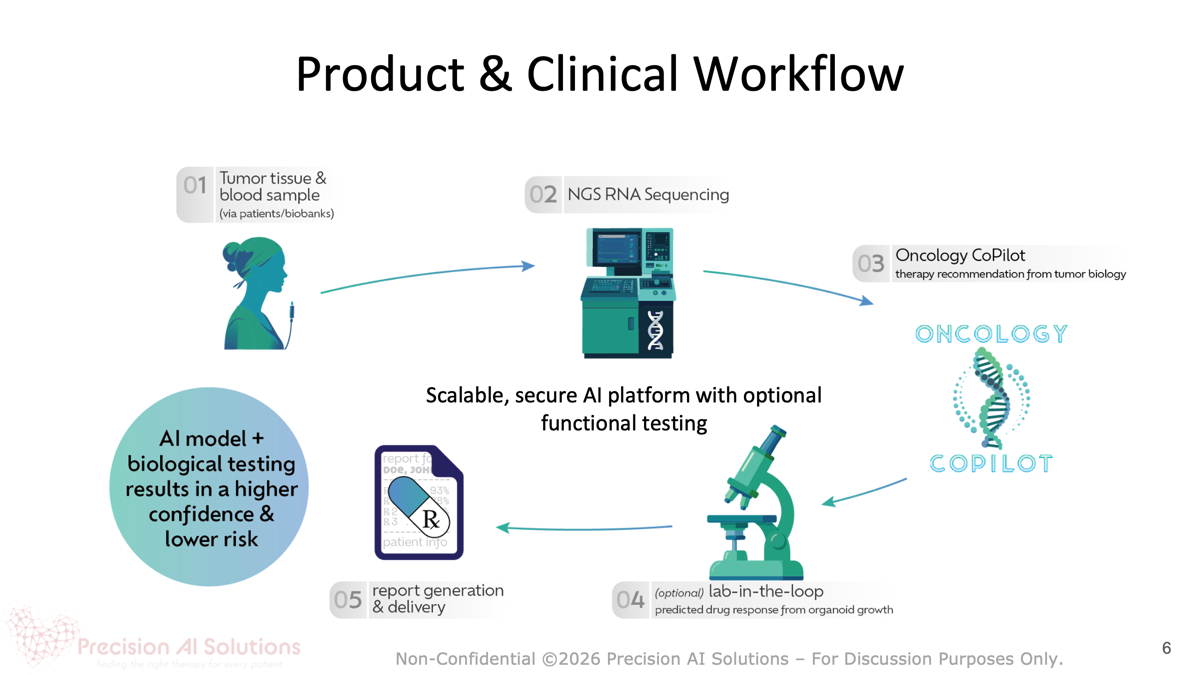
Precision AI Solutions and Cellentia have built a workflow to improve cancer care by combining (1) advanced testing (RNA sequencing), (2) an AI-driven analysis of the RNA sequencing for personalized treatment matching and recommendations, and (3) functional organoid testing to validate those recommendations. This approach aims to replace population-based "trial and error" methods with personalized, data-driven options delivered quickly to patients.
Meeting Summary
For many aggressive cancers, particularly pancreatic cancer, the standard treatment approach delivers very low success rates. Patients and families are often forced to make urgent decisions with incomplete information, navigating complex options under extreme time pressure. They face a triple challenge of limited actionability, toxicity, and timing, with little or no guidance. When a patient is diagnosed with pancreatic or a rare cancer, the issue isn’t whether data exist. The question is whether we can use that data fast enough and intelligently enough to make a difference.
Meanwhile, precision oncology has entered a new era of molecular insight. Tools such as RNA sequencing, AI, and advanced diagnostic tests provide unprecedented visibility into tumor biology. Yet translating that complexity into clear, personalized treatment decisions remains a major challenge. The result: innovation exists, but implementation lags.
Precision AI Solutions Co-founder and CEO Edwin Alphonso, CSO Sophia Ren, and Cellentia Research Partner Dr. SJ Shih, are uniquely qualified to discuss ways to use RNA-seq, AI, and functional testing for marking precise cancer care decisions.
Why do you need to know about cutting-edge tests and AI for finding your best treatment options?
RNA sequencing (which reads expression of ~20,000 genes) gives a broad, real‑time picture of your tumor biology that standard DNA panels or single biomarkers miss; it can identify likely drug sensitivity or resistance even when no actionable DNA mutations are present, enabling treatment options for you if you otherwise lack clear targets.
AI matching rapidly analyzes your detailed tumor biology to rank your most likely effective treatments, giving you and your medical team focused, personalized options faster than traditional methods
Functional tests (patient‑derived organoids from blood or tissue) can validate AI predictions in the lab to see which drugs actually kill your tumor cells and lower the risk of trying toxic, ineffective treatments
What are the adoption barriers to cutting-edge tests and AI for personalized cancer care?
Inertia: A "do no harm" mindset and reliance on traditional randomized clinical trials make it difficult for clinicians to shift away from established, population-based treatment pathways.
Technical Gaps: Current DNA tests often miss dynamic tumor behaviors, leading to decision paralysis when clinicians lack reliable, individual-specific biomarkers to guide care.
Evidence Hurdles: Significant cost constraints and a lack of standardized reimbursement persist because AI-driven predictions often lack the fast turnaround and functional validation payers require.
Access: Breakthrough precision technology remains largely confined to elite institutions, with slower access to poor and rural people.
What do you need to know about the limitations of using cutting-edge tests and AI in your cancer care decisions?
Understand the evidence: Cutting‑edge AI, RNA tests, and organoid results are probabilistic and often validated retrospectively or preclinically; look for prospective evidence for your cancer type.
Expect practical constraints: New technology may not work smoothly; tests can take days to weeks, samples may fail, and many platforms cover only approved drugs (not all trial/bespoke therapies); confirm turnaround, success rates, and which drugs/trials are evaluated.
Plan for access and cost: Promising recommendations may not be covered by insurance; clarify out‑of‑pocket costs, payer support for off‑label or functional validation, and how results will change your immediate treatment plan.
Engage your care team: Prepare a concise summary of your ideas to overcome inertia and resistance.
What can you do to use cutting-edge tests and AI to get your best treatment options?
Ask for more personalized testing: request comprehensive tumor profiling (whole-transcriptome RNA or validated panels) and ask if functional testing (organoids or liquid biopsy) is available to predict drug response.
Bring clear, simple questions to your medical team: “Which of the top 2–3 treatments is most likely to work for my tumor?” and ask for evidence level, alternatives (trials/off-label), and expected toxicities.
Advocate for coverage and second opinions: keep records, ask your team to help pursue coverage or trials, and seek a second opinion from centers doing RNA‑driven or organoid-guided care if your case is complex or standard options look unlikely to work.
How can you learn more about using new technology to find the best treatment for you?
Ask your doctor directly if RNA-based tumor profiling or functional testing (organoids/liquid biopsy) is appropriate for your cancer and treatment stage. Request how the results would change your treatment options.
See previous Cancer Patient Lab webinars on personalized cancer care, such as:
The information and opinions expressed on this website or platform, or during discussions and presentations (both verbal and written) are solely for educational purposes and are not intended as health care recommendations or medical advice by Cancer Patient Lab, its principals, presenters, participants, or representatives for any medical treatment, product, or course of action. You should always consult a doctor about your specific situation before pursuing any health care program, treatment, product or other course of action that might affect your health.
For the video recording, please see here.
For the slides, please see here.
For a transcript, please see here.