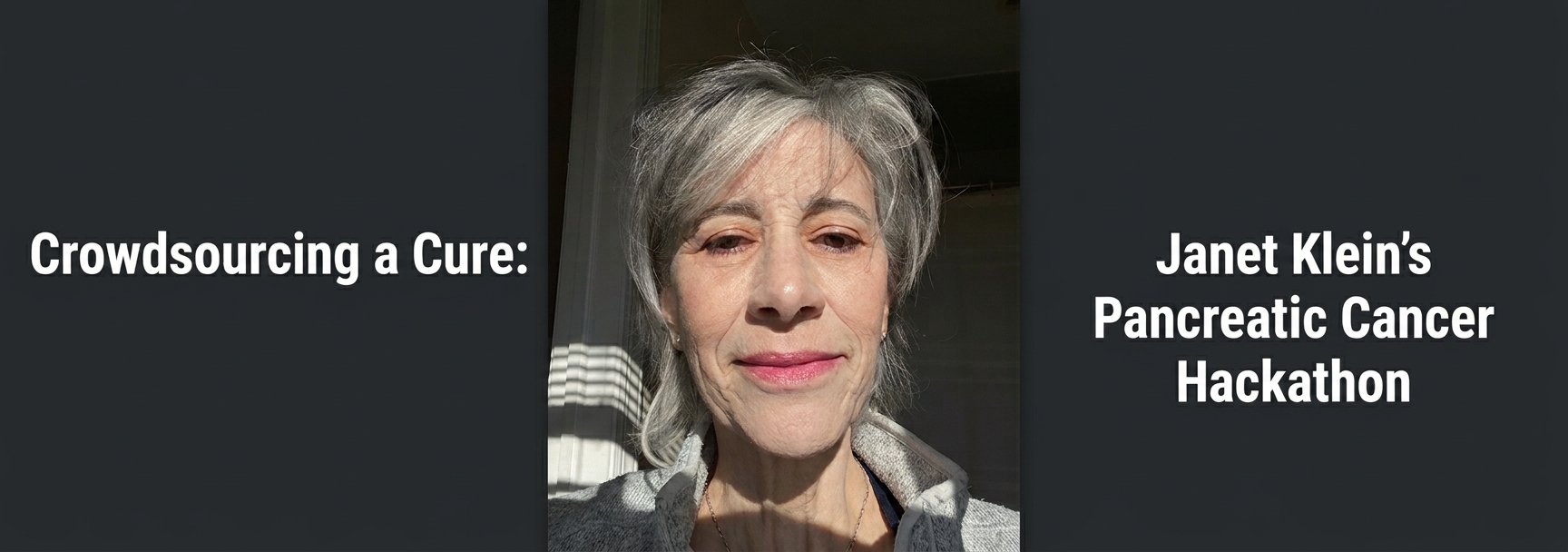
Janet Klein’s Pancreatic Cancer “Hackathon” [#220]
Brad Power
November 12, 2026
“Thank you from the bottom of my heart. I'm very interested in the stuff that Edwin was talking about that I don't even think I wouldn't even begin to know; there's something that you can do and that you don't really hear about in the hospitals where they have a zillion patients, and I don't know the right questions to ask. This has been immensely helpful, and I hope that without being greedy, I can do it again sometime.” – Janet Klein, pancreatic cancer survivor
“I also just want to say thank you, especially, Brad, to you for what you've built here. It's just really incredible. There's a lot of people who want to do the right thing, but they need a space like what you've created to do that, and I really want to thank the people who have experienced pancreatic cancer firsthand and who are here with your precious time and energy, Sam, Dennis, and Raj.” – Gina Siddiqui, MD
“It's funny that in the process of asking about this, a bunch of people with PDAC have come out of the woodwork. Someone has a relative. I would really like to try to codify as much as we can of what we're learning and put it out to all of you and bring together some of the tools and solutions and things that we are trying so that you can at least hear about that and think about it if it might fit your situation.” – Gina Siddiqui, MD
Overview
Join Janet Klein’s Cancer Care “Hackathon”
We’re bringing together a diverse team to help Janet Klein think through complex cancer-care questions. If you’re an experienced patient or caregiver, bioinformatician, clinician, or another relevant expert, we invite you to share your knowledge and perspective. Your input may help identify useful questions, testing options, and resources for Janet to discuss with her care team.
Summary
A Collaborative, Interdisciplinary “Hackathon” for Janet Klein, a Pancreatic Cancer Survivor
You are cordially invited to join an ongoing, multidisciplinary “hackathon” – a collaborative effort focused on Janet Klein, a pancreatic cancer patient who has made her comprehensive clinical and genomic datasets available to invited collaborators. Our dual mission is to chart the optimal clinical path forward for this patient and to generate foundational insights that can benefit the broader community of patients fighting pancreatic cancer. We are seeking long-term contributions from patients and caregivers, data scientists, bioinformaticians, immunologists, oncologists, and clinical trial experts to continuously analyze evolving data and solve complex side effects management, testing and treatment decisions, and overcoming systemic access hurdles.
What has been the story of Janet’s cancer care?
Janet Klein’s cancer journey began in March 2021, when doctors found a 3.6-centimeter tumor in the head of her pancreas and found cancer cells in 3 of 44 nearby lymph nodes. She had a major operation called a Whipple procedure to remove the tumor, though she faced several tough recovery challenges afterward. These included reduced blood flow to her liver, shrinking of part of her liver, narrowed blood vessels, and scar tissue in her bile ducts that caused repeated, serious bile duct infections requiring hospital and ICU care. After a long stretch without the cancer returning, scans in June 2026 showed that the cancer had spread to the lining of her abdomen and caused fluid buildup. A minor surgery to gather tissue did not provide enough sample for genetic testing, so she started two rounds of standard chemotherapy (nab-paclitaxel and gemcitabine) over the summer. In September 2026, Janet started taking a daily targeted pill called daraxonrasib at an adjusted dose (200mg). She tolerated it well, so her doctors increased the amount (to 300mg). Two weeks later, side effects—including fatigue, a skin rash, and bleeding gums—prompted her care team to lower the dose back down in November 2026 (to 200mg) while continuing to manage her bile duct blockages.
How can this “Hackathon” crowdsource an N-of-1 strategy for Janet?
This "Hackathon" builds a custom plan by bringing together cancer doctors, data scientists, genetics researchers, clinical trial specialists, patients, and caregivers to focus on Janet’s specific medical history. By looking at her scans, lab results, and past treatments side by side, researchers and data experts can spot hidden patterns to guide what therapies might work next, even without a large tissue sample for genetic testing. At the same time, clinical trial specialists search for newly opened studies or creative drug options and help navigate access hurdles, while experienced patients, caregivers, and doctors share practical ways to ease tough side effects like fatigue, skin rashes, bleeding gums, and bile duct blockages. Because Janet’s health is constantly evolving, the group continues to review new test results over time so her care team can adapt her treatment plan whenever her needs change.
What are the questions that Janet and her physician Gina would like to answer now?
Whether to do another biopsy: They want to weigh the risks and benefits of another procedure to collect tissue for genetic testing, asking if those results would truly change her treatment plan.
How to manage treatment side effects: They are looking for practical ways to protect her skin, care for her mouth and gums, and ease fatigue so she can stay comfortable on her daily targeted pill, daraxonrasib.
How to treat her bile duct blockages: They need to decide the safest way to manage her narrowed blood vessels and blocked bile ducts—such as using an internal stent, an external drain, or avoiding another procedure—to prevent serious infections.
What backup treatments to prepare: They are exploring next steps, including restarting chemotherapy or trying other emerging options, in case her body cannot stay on daraxonrasib long-term.
What answers to these questions were provided in the webinar launch event?
Reducing side effects: Raj said his doctors suggested a one-month break to reduce his side effects. Janet had lowered her dose, but the group didn’t know how quickly her side effects might improve.
Cholangitis warning signs: Janet said chills usually come first. Her care team had given her a plan for when to take antibiotics and when to seek stronger treatment. Raj uses a thermometer to track his fever and administer his antibiotics.
Nose and gum bleeding: Raj said an ENT doctor stopped his nosebleeds with a cauterization procedure. Raj said he uses a Water Pik with warm salt water to clean his teeth without bleeding. Alexander shared a medicine his periodontist had recommended for his bleeding gums.
Fatigue and other side effects: Sam, Roger, and others shared things that had helped them, such as walking, food changes, or ice packs for nerve pain.
Fluid buildup and stents: Dennis said a vein stent helped his fluid buildup.
More tumor testing: The group discussed checking older tissue, fluid samples, or blood for more information. Edwin offered to talk with Janet about a lab method that tests tumor cells against medicines.
Treatment options: Sam shared that he is getting a personalized neoantigen peptide vaccine, which Roger shared he also had, as well as other immune-cell treatments.
What resources are available to help us answer Janet’s questions going forward?
Full treatment and surgery timeline: a complete history of Janet’s care since 2021, including details from her Whipple surgery, past chemotherapy rounds, and her current dose changes on daraxonrasib.
Imaging scans and radiology reports: her CT and MRI scans over time to see how her tumor, liver, narrowed blood vessels, and bile ducts have changed.
Lab results and blood tests: trends in her blood counts, liver function tests, and tumor markers to see how her body is handling treatment and infections.
Pathology and tissue records: notes from her original surgery and her recent laparoscopy to understand why earlier tissue samples were too small for genetic testing and whether another biopsy is safe.
Daily symptom and side-effect logs: Janet’s firsthand notes on her fatigue, skin rash, gum bleeding, and hospital stays to suggest practical ways to keep her comfortable.
Published studies and clinical trial databases: compare Janet’s medical data against the latest scientific papers on RAS-targeted drugs, bile duct procedures, and open pancreatic cancer trials.
Why Participate? The Benefits of Contributing to This Hackathon
Directly help Janet and her care team: Your medical knowledge, data skills, or lived experience as a patient or caregiver can give Janet and Dr. Siddiqui practical ideas to ease side effects, prevent infections, and shape her next steps.
Learn from diverse perspectives: Working side by side with oncologists, surgeons, data scientists, researchers, and fellow patients lets you see how other fields approach complex pancreatic cancer problems.
Turn real-world data into better care: By studying a full timeline of scans, labs, and daily symptoms, contributors can help uncover patterns and side-effect solutions that rarely show up in standard medical textbooks.
Shape a new model for patient-centered research: Participating helps build a blueprint for N-of-1 problem solving that can be used to support other pancreatic cancer patients facing complicated decisions in the future.
Connect with a dedicated community: You will meet motivated peers, advocates, and experts who are committed to sharing knowledge openly and moving faster than traditional research allows.
How can you join the Hackathon for Janet and start helping?
Apply to join Janet’s Care Circle: Contact Dr. Gina Siddiqui at gina@carteclinics.com or Brad Power bradpower@cancerpatientlab.org and submit your background and how you would like to contribute to be admitted to see Janet’s data and join the conversation as part of her personal medical advisory team.
Join the Cancer Patient Lab community: Sign up for a free account on the Cancer Patient Lab platform, where the Hackathon task force is hosted and organized.
Review the launch webinar and case files: Watch the recording of the Launch Webinar for Janet Klein’s Pancreatic Cancer Hackathon and read her case summary to get up to speed on her medical history and top questions.
Introduce yourself in the pancreatic cancer forum: Visit the #Pancreatic Cancer discussion space to share your background—whether you bring medical training, research skills, or firsthand experience with similar treatments and side effects.
Share practical ideas and research: Post helpful articles, clinical trial matches, or real-world tips directly in the community threads so Janet and her care team can review them.
How can you learn more about “hackathons”?
See previous hackathons, including:
ND, a patient with diffuse stomach cancer
Hillel Bierbrier, a man with an aggressive anal cancer and limited treatment options
Bryce Olson, an advanced prostate cancer who had run out of options
Kasey Altman, a young woman with a rare cancer (rhabdomyosarcoma) which had no effective standard treatment options
Linnea Olson, a woman failing the targeted treatment she had received for her non-small cell lung cancer
Marlo Kwong, a 2-year-old with a rare sarcoma
Elliott Davis, a man who has been battling metastatic prostate cancer for 11 years, running out of treatment options
The information and opinions expressed on this website or platform, or during discussions and presentations (both verbal and written) are solely for educational purposes and are not intended as health care recommendations or medical advice by Cancer Patient Lab, its principals, presenters, participants, or representatives for any medical treatment, product, or course of action. You should always consult a doctor about your specific situation before pursuing any health care program, treatment, product or other course of action that might affect your health. This summary was prepared with the assistance of transcription and AI-assisted editing tools and was reviewed by Cancer Patient Lab staff.
For the video recording, please see here.
For a transcript of the conversation, please see here.